
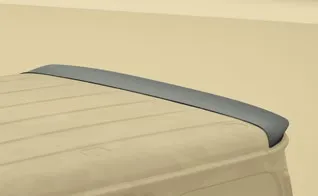
Roof wing for Mercedes G-class W463A Gronos


Roof Wing for Mercedes G-Class W463A Gronos
The roof trailing edge of the W463A G-Wagon presents an aerodynamic problem that no production G-Wagon has fully solved: the roofline terminates at a nearly vertical rear face, and the abrupt transition from a nearly horizontal roof surface to the upright tailgate creates a separated flow region that generates substantial base drag and buffeting in the near-wake. The Roof Wing, part of the Mansory Body Kit for Mercedes G-Class W463A Gronos, addresses this transition by placing a chord-profiled aerofoil section at the roof trailing edge — between the rear windscreen upper frame and the roof's outer flange — that manages the boundary-layer separation point and introduces a modest downward-pressure component on the rear of the vehicle. At the W463A's operating ride height of approximately 242 mm (standard air suspension mid-position) and with the roofline at approximately 1,925 mm above ground, the wing operates in air that is well clear of the vehicle's ground-effect zone, meaning its performance is governed by freestream conditions rather than road-surface interference.
Construction & Materials
The Roof Wing is produced from a glass-fibre reinforced polymer (GFRP) core with an exterior prime-ready surface, supplied as a complete assembly with the wing element and the two side endplates that locate it on the W463A's rear roofline flange. The GFRP construction delivers the wall thickness required for the wing's chord-profiled cross-section — typically 4.0–5.0 mm wall on the wing pressure face and 3.0–3.5 mm on the suction face — without excessive weight, keeping the assembly mass at the roof's rear edge from adversely affecting the W463A's lateral stability characteristics on uneven terrain.
The paint-ready surface finish allows the wing to be body-colour matched at any qualified body shop, using either a Mercedes-Benz factory colour code or a custom mix. The GFRP surface is primed at 60–80 µm epoxy build, block-sanded to 400-grit, and compatible with 1K and 2K solvent-borne and waterborne topcoat systems with a 5–10% flex additive recommended for the GFRP substrate. For owners who want a visible-carbon wing face, the Roof Wing Visible Carbon variant in the same Gronos programme provides that finish without requiring paint.
- Core laminate: glass-fibre reinforced polymer (GFRP) vacuum-infusion — structural efficiency sized to the W463A roof trailing-edge mounting loads at motorway speed
- Wing profile: asymmetric chord-profiled section with moderate camber — provides usable downforce on the W463A rear at speeds above 80 km/h without high drag penalty
- Endplates: GFRP, integrated with wing element — locate the wing on the roofline flange at two retention bolts per side
- Wall thickness: 4.0–5.0 mm pressure face; 3.0–3.5 mm suction face
- Assembly weight: approximately 1.8–2.4 kg including hardware
- Surface finish: two-component epoxy primer at 60–80 µm, block-sanded to 400-grit — paint-ready
- Mounting: four stainless-steel M6 bolts through roofline flange; wing to flange sealed with closed-cell foam weatherstrip to prevent water ingress
- Wind-noise sealing: elastomer seal between wing underside and rear windscreen upper frame — eliminates resonance whistle at motorway speed
Design & Visual Function
The W463A's roof, viewed in profile, is unusual: a flat rectangular panel approximately 1,580 mm long and 1,820 mm wide, bounded at its forward edge by the A-pillars and at its rear edge by the near-vertical D-pillars. This flat geometry means the roof acts as a near-perfect diffuser approach surface — the incoming air that stagnates on the windscreen base travels across this flat roof in a thin, accelerating boundary layer, arriving at the trailing edge at higher velocity than the underbody air that arrives at the floor. The Roof Wing exploits this velocity surplus by placing its chord profile at the exact point where this accelerated roof-surface airflow would otherwise detach over the tailgate. The wing's pressure face extends rearward and slightly downward beyond the roof's trailing edge line, intercepting the departing boundary layer before separation and redirecting it at a small negative angle that contributes to rear-axle load stability at speed.
Visually, the Roof Wing adds a horizontal datum line at the very top of the W463A's profile — a continuous element that spans the roof width between its two endplates and reads as a deliberate architectural addition to the vehicle's silhouette from any side or rear-three-quarter viewpoint. On the G-Wagon's tall, vertical-dominant silhouette, this horizontal element at the roofline provides a strong visual termination point for the roofline that the OEM tailgate edge alone does not deliver. The wing sits above the D-pillar upper termination, framing the rear face of the vehicle between its lateral endplates in a way that reads as simultaneously functional and composed. In body colour, the wing integrates into the W463A's silhouette more discreetly than the visible-carbon variant — suited to builds where the aerodynamic benefit is valued without the explicit material declaration.
Compatibility & Fitment
The Roof Wing fits Mercedes-Benz G-Class W463A 2018 to present. The mounting interface is the W463A's roof trailing-edge flange — a structural steel flange at the roof panel's rear edge that is shared across G63 AMG and G500/G550 variants. LHD and RHD body configurations use the same roof geometry on the W463A. The post-2024 cosmetic facelift did not alter the roof geometry or trailing-edge flange profile. The wing assembly's mounting bolt pattern is specific to the W463A roofline flange; it is NOT compatible with the pre-2018 W463 or the W464 G-Wagen 4×4².
Installation & Reversibility
Installation requires a ramp or stable platform to access the roof trailing edge from above or from a step ladder at the vehicle's side. The closed-cell foam weatherstrip is applied to the wing mounting face before fitting. The wing is positioned on the roofline flange, oriented parallel to the roof trailing-edge line, and the four M6 stainless-steel bolts are installed through the endplate mounting holes into the flange at hand-tight. Gap between the wing underside and the rear windscreen upper frame is checked — target 15–25 mm uniform clearance at mid-span — before final torque. The elastomer seal between wing underside and windscreen frame is pressed into the gap after final torque to eliminate resonance paths. Installation time: 1.5–2.5 hours including paint cure (if wing is painted separately before fitting). The wing is fully reversible — the flange accepts the OEM roof trim strip after wing removal without structural modification.
Pairing within the Mansory Gronos programme
The standard Roof Wing pairs well with a body-colour exterior specification. For a visible-carbon version of the same wing geometry, the Roof Wing Visible Carbon provides the same profile in a clearcoated 3K twill prepreg finish. For a more assertive aero statement at the roofline, the High Roof Wing offers a taller profile at the same mounting position. At the upper front of the vehicle, the A-Pillar / Front and Side Roof Cover extends the Gronos programme from the windscreen base along the full roof periphery, creating a programme-coherent frame for the roof surface that the Roof Wing terminates at its rear edge.
Maintenance & Durability
The painted GFRP wing surface should be maintained in the same manner as any exterior painted panel: pH-neutral wash, no alkaline pre-soak dwell, no abrasive polishing compounds on the clearcoat. The wing's physical position at the roof trailing edge means it receives the highest-velocity airflow on the vehicle — road film, insect debris, and stone chip from the wake turbulence behind following vehicles all deposit on the wing's suction face at higher concentration than on lower body panels. A targeted pressure-rinse of the wing's suction face and the endplate inner surfaces after each motorway run removes accumulated debris before it bonds to the clearcoat surface. Check the weatherstrip seal between wing underside and windscreen frame at each annual service — the elastomer seal compresses under cyclic loading from wind pressure and may need replacement after 3–5 years to maintain its resonance-damping function.
Stone-chip at the leading edge of the wing is more frequent than on the rear body panels because the leading edge intercepts impact-deflected debris from the roof surface airstream. A clear paint-protection film on the wing leading edge (typically 30–50 mm chord from the leading edge) substantially reduces chip accumulation in this zone. The GFRP substrate under the paint finish will absorb minor stone impacts elastically without fracture — an advantage over carbon variants at this location.
Lead Time & Warranty
Lead time for the Roof Wing (paint-ready) is 2–4 weeks from order. The assembly carries a 12-month warranty against manufacturing defects — GFRP void formation, primer adhesion failures, mounting hardware failures, and weatherstrip sealing defects. Damage from stone-chip impact and clearcoat damage from pressure-washing at short range are not covered.
FAQ
Q: How much downforce does the Roof Wing generate on the W463A?
A: At 120 km/h the wing generates approximately 8–15 kg of downforce on the rear axle, depending on exact ambient temperature and vehicle loading. This is modest relative to the W463A's 2,560 kg+ kerb weight but meaningful at the rear axle stability level — reducing the tendency of the rear end to float on long high-speed motorway sections.
Q: Does the wing produce any audible wind noise at motorway speed?
A: With the elastomer seal between the wing underside and the windscreen frame correctly installed, no resonance whistle is expected below 200 km/h. If a whistle develops after prolonged use, inspect the elastomer seal for compression-set and replace if needed.
Q: Can the wing be painted in a contrast colour to the body?
A: Yes. Some W463A builds specify the roof wing in a contrast colour — black wing on a white body, for example — to echo the G-Wagon's factory two-tone roof specification. The GFRP substrate accepts any standard automotive colour.
Q: Is there a visible-carbon version of the same standard-height wing?
A: Yes — the Roof Wing Visible Carbon in the same Gronos programme provides the same chord-profiled geometry in autoclave-cured 3K twill carbon with UV-stable clearcoat rather than paint-ready finish.
Q: Will the Roof Wing fit if I have an aftermarket roof rack system on my W463A?
A: Roof rack mounting points are typically at the roof rail brackets inboard of the trailing edge flange. If the roof rack does not occupy the trailing-edge flange zone, the wing can be fitted. Confirm clearance between the roof rack rear cross-bar and the wing endplate positions before ordering.
Configure your Roof Wing specification with the Hodoor Mansory team: Contact us via WhatsApp +44 7488 818 747 or [email protected].