Mansory Carbon Fiber Body kit set for Maserati Ghibli


MANSORY Carbon Fibre Body-Kit Set for the MASERATI GHIBLI III (M157, 2013-2024) — Modena's Volume-Seller Executive Saloon, Now a Value-Tuning Brief on Ferrari-Built V6 and V8 Architecture
The Maserati Ghibli III (internal chassis code M157, in production from 2013 to 2024) is the third car in Maserati history to wear the Ghibli name and the only one positioned as a true volume-segment executive saloon — Modena's direct rival to the Mercedes-Benz E-Class, BMW 5 Series and Audi A6, sitting one tier below the larger Quattroporte VI (M156) with which it shares its platform, assembly line and most mechanical hardware. Production ran for eleven years across an initial launch range, a 2018 facelift, the Trofeo V8 flagship in 2020, GranLusso and GranSport trims in 2021, and a mild-hybrid four-cylinder variant — before being quietly retired in 2024 with no direct internal-combustion replacement, as Maserati pivoted to the Grecale SUV, the MC20 family and the electrification of the GranTurismo and GranCabrio. Ghibli's role inside the Maserati hierarchy was always commercial rather than emotional: it was the saloon that made Trident ownership possible at near-German-premium prices, and the Mansory programme reads its buyer correctly. This is a carbon-fibre body-kit set conceived as value-tuning, not statement-of-wealth — a coherent, factory-tone Mansory upgrade for cars that change hands at €40 000-€80 000 second-hand and deserve a louder visual presence than Maserati's own catalogue gave them.
The Ghibli III generation in Maserati's volume context
Maserati launched the M157 Ghibli in late 2013 against an explicit volume target — the company's then-strategy under Sergio Marchionne was to multiply Maserati output roughly five-fold by 2018, and the Ghibli was the saloon that had to do most of that lifting. It launched in three trims: the entry Ghibli with a 330 hp twin-turbo V6 petrol, the Ghibli S with the same V6 tuned to 410 hp (rear-drive or, in the S Q4, all-wheel drive), and the Ghibli Diesel with a 275 hp V6 turbodiesel sourced via VM Motori — the first diesel Maserati ever offered, and the variant that genuinely opened the door for European fleet buyers before being phased out of most markets by 2020. The 2018 facelift brought new front and rear bumpers, a redesigned grille, updated lighting and an interior-electronics refresh. In 2020 Maserati added two contrasting derivatives: a mild-hybrid 2.0 L four-cylinder at 330 hp at the bottom of the range, and the Ghibli Trofeo at the top — the same 3.8 L twin-turbo F154 V8 producing 580 hp that powers the Levante and Quattroporte Trofeo trims, lifting Ghibli into a 326 km/h, 4.3 s 0-100 km/h supersedan that almost no one knew Maserati made. 2021 brought the GranLusso and GranSport trim splits. Across the eleven-year run total volume reached approximately 70 000-80 000 units globally — Ghibli outsold the Quattroporte VI, made the Trident a credible saloon brand again, and quietly bowed out in 2024.
Where Mansory adds and where Mansory subtracts — the value-tuning brief
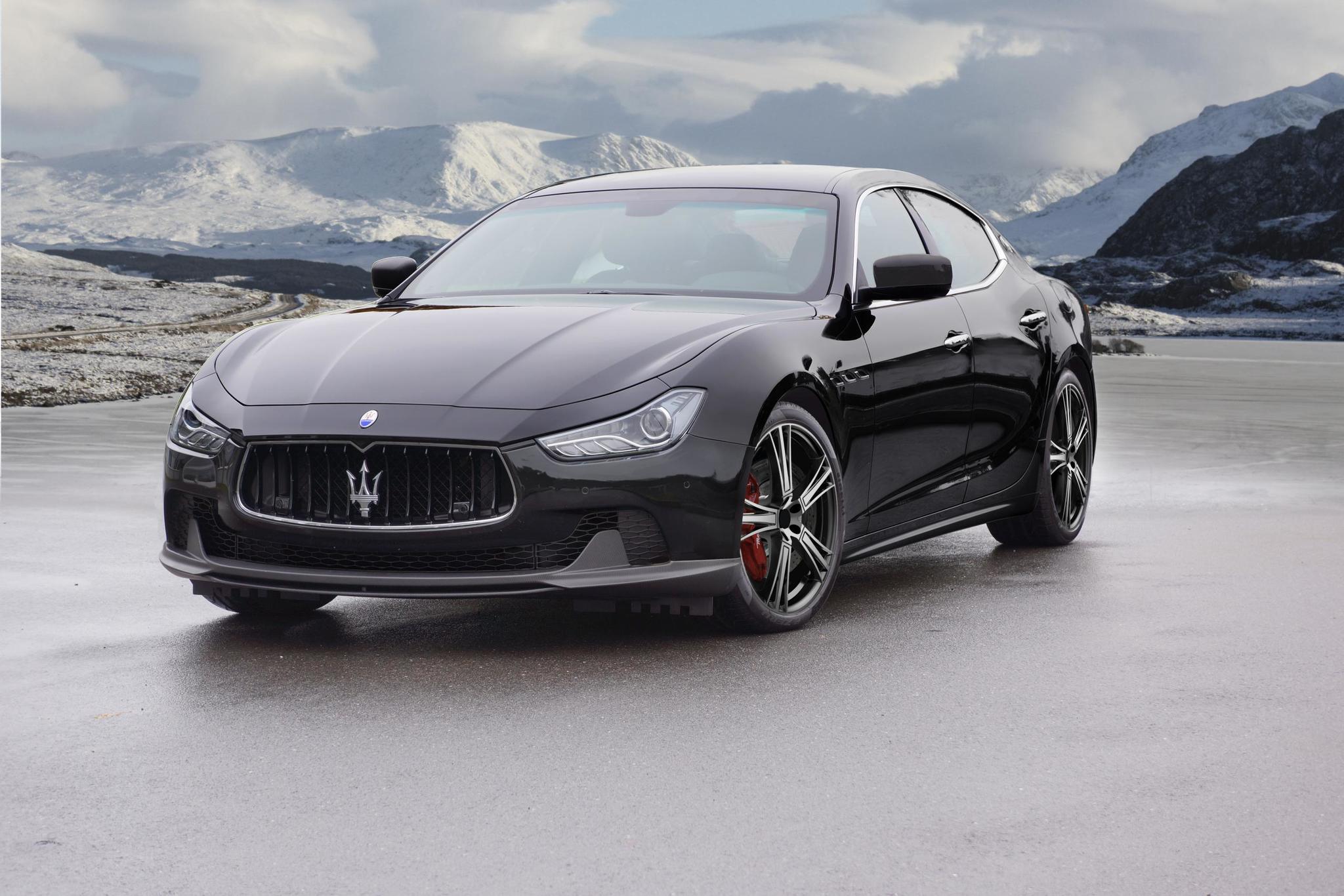
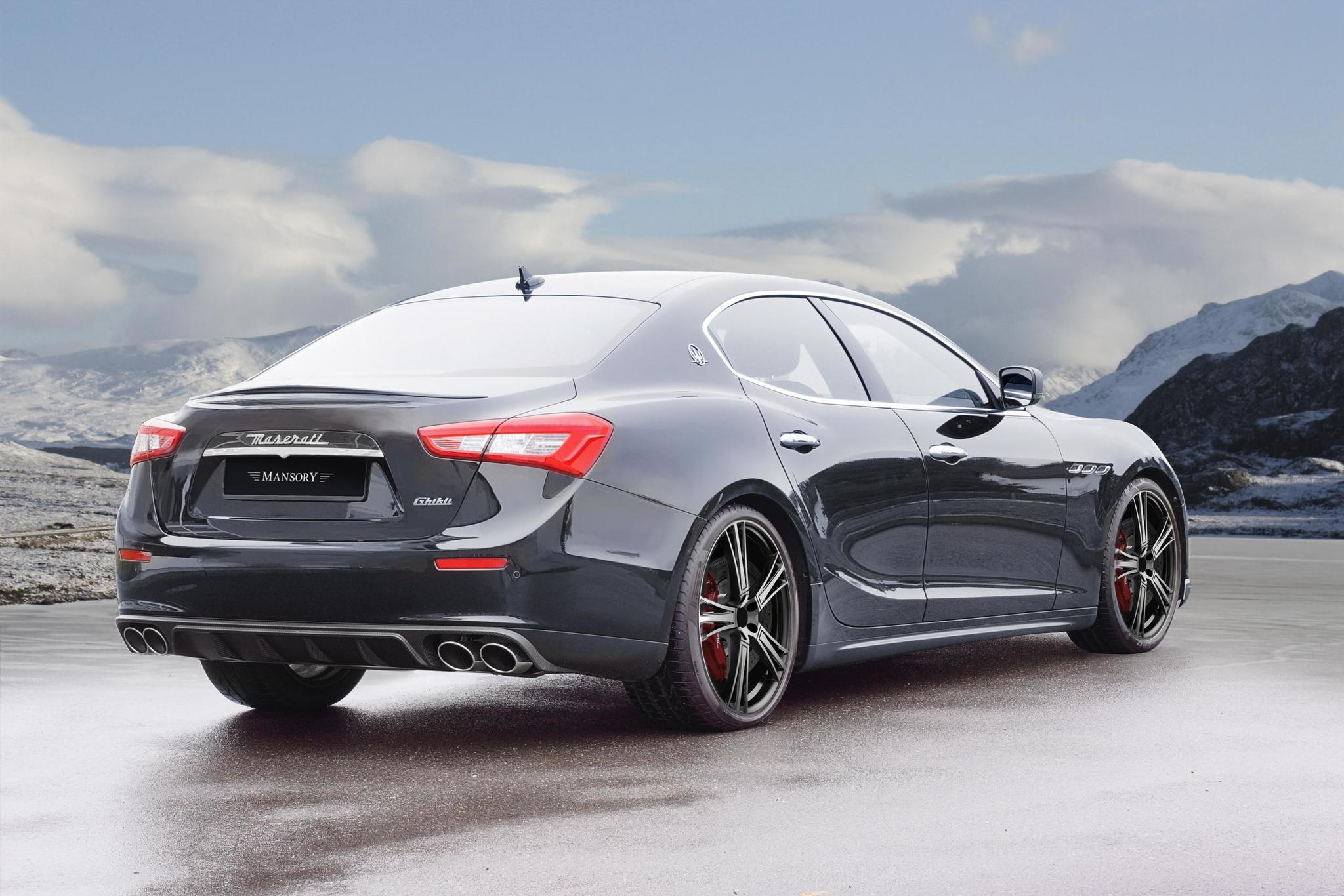
Ghibli is in many ways Mansory's most pragmatic Maserati programme. The buyers commissioning this kit are not Quattroporte buyers and they are very rarely first-owners — they are clients who bought a £45 000 pre-owned Ghibli or a €60 000 facelift S Q4 and want it to read on the street like a £150 000 MC20-aesthetic car. The brief is upgrade-on-budget, not statement-of-wealth, and Mansory has stopped pretending otherwise on this one. So the kit is deliberately disciplined: no widebody fender flares, no rebodied bonnet, no full bumper replacement of the kind the Aventador or Bentayga programmes rely on. The interventions are surface-applied carbon panels that sharpen the M157's existing executive-saloon silhouette without fighting it. What Mansory adds: aerodynamic carbon edges (front lip, splitter, air-intake lip, rear diffuser, deck-lid spoiler) that re-balance the Ghibli's long-bonnet stance toward the more aggressive Trofeo language. What Mansory deliberately subtracts: the urge to over-extend the bodywork. The Ghibli's Modena-drawn proportions are too long-cab and too saloon-formal to absorb a widebody conversion; Mansory's restraint here is the point of the programme.
Carbon body-kit components
Mansory Ghibli M157 carbon component schedule: Front lip — bonded carbon front lip extending the lower fascia downward by approximately 35 mm with a sharper leading edge; Splitter Front lip — additional carbon splitter element overlaying the front lip for owners specifying the more aggressive front-end configuration; Air intake Front lip — flanking carbon intake-frame inserts that re-frame the factory side intakes in exposed twill weave; Rear diffuser — full carbon rear-diffuser unit with vertical strakes, bolt-on replacement of the painted factory diffuser panel, exhaust-cutout integration matched to factory four-pipe exit; Rear deck-lid spoiler — sculpted carbon boot-lid lip-spoiler in low-drag profile, factory-style adhesive bond; Mirror masks — carbon mirror-housing covers (overlay style, no impact on factory blind-spot or camera modules); Side panels — bonded carbon side-skirt overlays running the full length of the rocker panels, integrating with the front lip and rear diffuser to create a continuous carbon line around the lower bodywork. Optional additions: carbon mirror-stalk inserts, carbon B-pillar trim panels, and a Mansory stainless-steel valved sports exhaust system tuned to the F160 V6 TT or F154 V8 (Trofeo). Pre-preg autoclave-cured carbon, gloss or satin lacquer, with full Trofeo-spec carbon weave continuity available for owners who want the kit to read as factory.
3.0 V6 TT (M157) — Ferrari-Maranello-built engines in a Maserati saloon
The detail that separates Ghibli III from its German segment rivals is engine provenance. The 3.0 L twin-turbocharged V6 (Maserati internal designation F160) is built at Ferrari's Maranello facility on the same line as the Ferrari California T and Portofino V8s — it is a 90° V6 derived from Ferrari's modern V8 architecture rather than a Modena-engineered unit. In Ghibli it appears in three states of tune across the production run: 330 hp / 500 Nm in the base car, 410 hp / 550 Nm in the Ghibli S and S Q4, and a 350 hp interim tune mid-cycle. All variants drive through a ZF 8HP 8-speed automatic, rear-wheel drive on most trims, with the Q4 system on S Q4 offering on-demand all-wheel drive via a clutch-pack transfer case. The 2020 Ghibli Trofeo swaps this V6 for the Ferrari-built 3.8 L twin-turbo F154 V8 at 580 hp / 730 Nm — the same engine family that powers the Ferrari California T, Portofino, GTC4Lusso T and Roma — turning the M157 into a 326 km/h saloon. The 2.0 mild-hybrid four-cylinder added in 2020 sits outside this Ferrari-engine lineage. Other M157 hardware: rear-wheel-drive or Q4 AWD, double-wishbone front / multi-link rear suspension, Skyhook adaptive dampers optional, Brembo brakes throughout. Dimensions: 4 971 × 1 945 × 1 461 mm, wheelbase 2 998 mm, kerb weight 1 810-1 950 kg depending on trim. Assembly: Modena (Avvocato Giovanni Agnelli plant), shared line with Quattroporte VI.
Wheels — 21" forged for the Ghibli
Factory Ghibli wheel sizing across the production run was 18"-20" depending on trim, with the Trofeo carrying a 21" forged design. Mansory's preferred Ghibli fitment is 21" forged staggered, sized to fill the M157's wheel-arches without disturbing the factory suspension geometry or ride-height calibration. Recommended Mansory patterns for the Ghibli: M.7 seven-spoke evolution and FD.16 dual-spoke concave — both designs that visually elongate the saloon's profile rather than fighting it. Tyre fitment: 275/30 R21 staggered, with the rear-axle rolling diameter calibrated to preserve factory ABS, ESP and ADAS calibration. Finishes: gloss anthracite, satin black, polished bronze, brushed titanium, and full Italian paint-to-sample (Blu Nobile, Grigio Maratea, Rosso Energia, Nero Ribelle to colour-match factory Maserati palettes). All wheels TÜV-documented for Ghibli kerb weight up to 1 950 kg and Trofeo high-speed envelope. Full forged catalogue: hodoor.world/collection/forgedwheels.
Resale-resilient corridor
The Ghibli's resale-resilient corridors today are Italy, the GCC and Russia — discreet markets where Trofeo trims trade hands without ceremony.
Commission
To commission the Mansory Ghibli M157 carbon-fibre body-kit set, supply: VIN; donor trim (base V6 / S / S Q4 / Diesel / mild-hybrid 4-cyl / Trofeo V8); pre- or post-2018 facelift; current paint code; carbon weave preference (gloss or satin); wheel pattern (M.7 or FD.16) and finish; optional sports-exhaust scope; and destination country. Lead times: 8-10 weeks carbon panels and wheels; +2 weeks if exhaust is specified; installation 1-2 weeks at a Maserati-experienced workshop. Total order-to-road: approximately 12 weeks. Email [email protected] or message us on WhatsApp at wa.me/447488818747.
FAQ — Mansory Ghibli M157
Does the kit fit both pre- and post-2018 facelift Ghibli M157 cars? Yes — front-lip and splitter geometry is produced in two specifications to match the pre-facelift and 2018+ facelift bumper profiles; specify model year on commission.
Is the carbon kit interchangeable with the Quattroporte VI (M156) programme? No — although Ghibli and Quattroporte share the M156/M157 platform, the bumpers, sills and decklid geometry differ; the carbon panels are Ghibli-specific.
Does the body-kit installation affect Ghibli ADAS, parking sensors or Skyhook calibration? No — all panels are surface-applied or bolt-on, factory radar and ultrasonic sensor positions are preserved, and Skyhook damper calibration is unchanged.
Can the kit be combined with a Ferrari-built F160 V6 or F154 V8 reflash? Yes — Mansory offers a separate ECU remap programme for both engines (approximately +40 hp on the 3.0 V6 TT, +50 hp on the 3.8 V8 Trofeo) commissioned independently of the body-kit programme.