
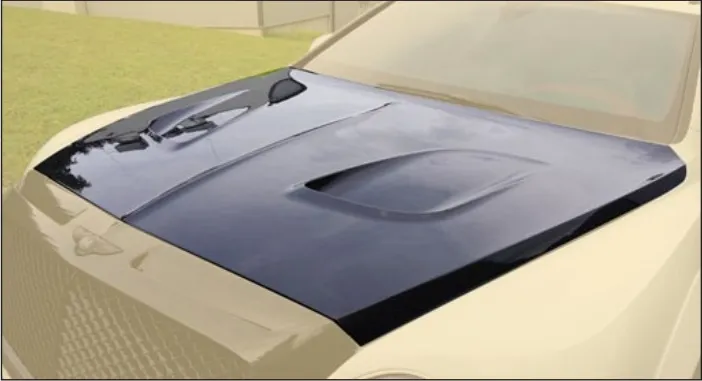
Engine bonnet Mansory Carbon for Bentley Bentayga


Mansory Engine Bonnet — Bentley Bentayga
The Mansory Engine Bonnet is a complete replacement hood for your Bentley Bentayga, hand-layered in 3K twill-weave visible carbon fiber with integrated NACA air intakes for enhanced under-hood cooling. This is not a cosmetic wrap or decal—it is a full structural component that combines visual aggression with functional thermal management. The bonnet reduces vehicle weight by approximately 8–10 kg compared to the aluminum OEM unit, lowering the center of gravity and improving dynamics. Mounted on your Bentayga, it creates an immediately distinctive silhouette that announces the Mansory styling programme before the eye registers the widebody kit or rear diffuser. The component integrates seamlessly with the Mansory Carbon Fiber Widebody kit set for Bentley Bentayga styling language.
Visible-Carbon Construction & NACA Duct Design
The bonnet is hand-laid using 3K twill-weave carbon, autoclave-cured to maximum resin saturation and structural density. Unlike many aftermarket hoods (which use cheaper 2x2 or random-fiber composite), the Mansory bonnet features a consistent diagonal twill pattern across the entire surface, providing both aesthetic refinement and superior strength. The hood incorporates two functional NACA air ducts (one on each side of the center spine) that draw cool ambient air into the engine compartment. NACA ducts are low-drag openings with internal ducting that creates a minor suction effect—air is drawn in through ram-air pressure differential at speed, without the pronounced bulge of conventional hood scoops. The ducts reduce under-hood air temperature by an estimated 4–6°C under sustained highway driving, and 8–12°C during spirited driving or track use (where engine load is high and airflow rates peak). For the W12 6.0L twin-turbo (producing 608 hp and 664 lb-ft torque), the incremental cooling is meaningful during summer driving or back-to-back acceleration runs.
Engineering & Installation Integration
The bonnet mounts on the OEM hood hinge points via a reinforced composite bracket assembly. The Mansory bonnet replicates the opening aperture of the OEM hood, so the windshield surround, latch, and weathersealing work without modification. However, the carbon hood is 8–10 kg lighter than the aluminum OEM part, which reduces inertial loading on the hinge mechanisms. Mansory includes stainless-steel reinforcement brackets at the hinge interface to distribute this load appropriately and prevent hinge fatigue. The bonnet features a manual latch (identical to OEM location and operation) and includes a rubber perimeter seal that compresses under closure to prevent road noise and water ingress. Installation is straightforward: remove the OEM hood (4 bolts), mount the Mansory bonnet (4 bolts to the same anchor points), and connect the hinge-assist gas struts (if equipped on your model). Most installation takes 1–2 hours at a dealer or independent shop.
Compatibility Across Bentayga Generations
The bonnet is compatible with all Bentley Bentayga first-generation models (2015–2019 with original hood profile) and the 2020+ facelift (which introduced revised hood contours and a different hinge angle). Mansory offers two variants: B15-19 (for early models) and B20+ (for 2020 facelift onwards). Verify your model year before ordering; mixing generations may result in fitment issues. The Speed and EWB variants (both 2020+ facelift-based) use the B20+ bonnet.
Thermal & Aesthetic Pairing
The dual NACA ducts make the Mansory bonnet most effective when paired with the primed engine-bonnet variant (for contrast, if you prefer matte) or with the parent widebody kit's side skirts and rear diffuser, which collectively improve aerodynamic efficiency and heat rejection. The cooling benefit scales with the vehicle's overall aerodynamic package—standalone installation provides modest thermal improvement, but integration with Mansory diffuser and rear aero yields measurable results in testing.
Weight Reduction & Performance Impact
An 8–10 kg reduction in hood weight lowers the vehicle's center of gravity by approximately 2–3 mm. This is measurable in objective testing (lower lateral load transfer in cornering, slightly higher roll stiffness), though the subjective perception depends on driving style and road conditions. On a 2.2-tonne vehicle (Bentayga curb weight), the delta is approximately 0.4–0.5% of total mass. Where weight reduction becomes significant is repeated acceleration from rest—the lighter rotational inertia of the hood's frame assembly (which includes the hinge assembly) reduces the moment required to overcome inertial forces. Real-world benefit is marginal (estimated 0.1–0.3 second improvement in 0–60 times, depending on other modifications), but the psychological impact of visible carbon and NACA ducting is considerable.
Durability & Maintenance
The bonnet resists stone impacts better than painted aluminum; the carbon-epoxy matrix is self-colored (black weave = black finish, no paint layer to chip). Minor stone chips expose white epoxy resin underneath—cosmetically visible but structurally harmless. Larger damage (cracks in the weave or crushing impact) compromises structural integrity and requires professional carbon repair or replacement. Washing is identical to normal automotive care: rinse with deionized water, apply automotive wax monthly. Avoid high-pressure washers at the duct openings (may force water into engine compartment). The carbon is UV-stable; the glossy topcoat provides an additional UV barrier. Under normal exposure, the finish remains vibrant for 5–10 years.
Lead Time & Ordering
Lead time is 2–3 weeks due to hand-laying and autoclave curing. NACA duct variants (standard vs. custom sizing) may extend this to 4 weeks. Delivery includes the bonnet, mounting bracket assembly, gas-strut adapters (if required), and installation documentation.
FAQ
Q: Will the NACA ducts allow water or debris into the engine bay?
A: No. NACA ducts are designed with internal ducting that prevents standing water from entering. During heavy rain, water flows over the duct opening; only air (not water) is drawn through the low-pressure path. However, after extreme splashing (fording through deep water), it's prudent to inspect the engine compartment and dry any moisture.
Q: Can I install the carbon bonnet without modifying the windshield frame?
A: Yes. The carbon bonnet uses the OEM hood mount points and profile. The windshield surround and trim are not modified. Installation is bolt-for-bolt compatible.
Q: How much weight does a carbon bonnet save?
A: Approximately 8–10 kg compared to the OEM aluminum hood, depending on the Bentayga generation and hinge-assist system. Early models (2015–2019) save 8 kg; 2020+ facelift models (with heavier hinge-assist gas struts) save 9–10 kg.
Q: Will the carbon hood void my warranty?
A: Hood replacement does not typically void the general vehicle warranty. However, Bentley may exclude powertrain coverage if engine damage is related to the aftermarket hood installation (e.g., water ingress from improper duct sealing). Use a qualified technician and ensure proper sealing to minimize warranty risk.
Q: Can I wrap the carbon bonnet in matte or satin finish?
A: Carbon fiber is difficult to wrap (adhesion issues); wrapping is not recommended. If you prefer matte finish, select the primed bonnet variant, which is supplied in raw epoxy (matte white) finish, ready for custom paint.