
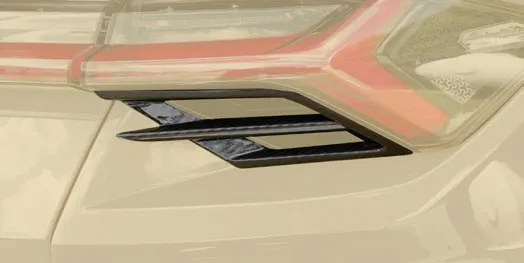
Air vent tail light Mansory for Lamborghini Urus Venatus


Mansory Air Vent at Tail-Light for Lamborghini Urus Venatus
The carbon air vent at the tail-light is one of the quieter but functionally smarter pieces in the Mansory Body Kit for Lamborghini Urus Venatus S programme. Sitting alongside the OEM tail-light cluster, this slatted carbon outlet is a pressure-release vent for the rear bumper area — even on a road-going super-SUV with a 4.0 twin-turbocharged V8, the rear bumper traps a measurable column of air behind the rear wheel, and giving that air a defined exit reduces low-speed drag turbulence and tidies the wake behind the car. Visually it frames the tail-light, picks up the weave alignment of the rear-splitter and the rear-decklid spoiler line, and turns the rear quarter from a flat clamshell panel into a layered, motorsport-derived surface that matches the hexagonal Lamborghini DNA of the Venatus body.
Construction & Materials
The vent is moulded as a single carbon shell with an integrated slatted face. Mansory uses a 3K twill outer ply for visual depth, with an internal woven scrim to keep the slats rigid under thermal cycling from the hot tail-light bulb housing and the road-heated rear bumper skin. The piece is supplied finished from the factory, ready to bond directly to the prepared OEM bumper aperture.
- 3K twill carbon outer weave, 2x2 pattern, weave-aligned with the rear-splitter and rear-decklid spoiler.
- Prepreg lay-up cured in autoclave at controlled temperature and pressure for void-free lamination.
- Wall thickness 1.6–2.0 mm across the shell, locally reinforced at the slat root to resist warp.
- Mass approximately 0.45–0.65 kg per side depending on production batch.
- Mansory deep-gloss UV-stable lacquer over the visible weave; matte and satin finishes available on request.
- 3M VHB structural acrylic tape pre-applied around the bond perimeter, plus two hidden plastic clips that locate into the OEM bumper substructure.
- Internal slat geometry oriented to bias airflow rearward and slightly outboard, away from the tail-light lens.
- UV-stable clear coat tested for long-term exposure without yellowing or weave-blooming.
Design & Visual Function
Functionally, the vent is about rear-end air-pressure management. The Urus runs a near-flat underbody and a relatively short rear overhang, which means air that has travelled along the side of the car and around the rear wheel arrives at the rear bumper with measurable static pressure. On a stock car, that air spills around the bumper edge in an uncontrolled way, contributing to the turbulent wake behind the SUV at motorway speed. The Mansory tail-light vent gives that air a defined, slatted exit, releasing trapped pressure outboard of the OEM exhaust tips and tidying the flow behind the car. It is not a downforce-generating device — it is a pressure-relief and wake-cleanup feature, and that nuance matters when an owner asks what it actually does.
Visually, the vent is one of the most satisfying small details on the Venatus rear quarter. The slats run weave-aligned with the rear-splitter blades and pick up the diagonal axis of the rear-decklid spoiler shoulder, so the rear of the car reads as a single resolved composition rather than three separate carbon pieces glued near each other. Owners who specify the full rear-quarter set — vent + splitter + decklid spoiler — describe the result as the car finally looking finished from behind, with the OEM tail-light cluster framed by carbon rather than floating on a flat painted bumper.
For owners who choose only one or two rear pieces, the air vent is the highest-impact-per-gram option: small, structural, immediately visible from any three-quarter angle, and without the visual heft of a full performance wing or large spoiler. It works equally well on Pearl Capsule body colours, where the carbon weave reads as a contrasting accent, and on darker hues, where the slat geometry catches highlights and gives the rear quarter depth.
Compatibility & Fitment
The vent fits the Lamborghini Urus, Urus S and Urus Performante (2018–present), including post-2022 facelift cars. The slug uses generic Venatus naming because these parts retrofit across the Urus line — the rear-bumper aperture geometry is shared. The OEM tail-light cluster is unaffected: the vent sits adjacent to the lens, not over it, and the slat lip is offset from the OEM lens edge to preserve the factory light signature and DOT/ECE certification of the rear lighting. Parking sensors, reversing camera, and rear radar coverage are not impacted because the vent occupies a passive bumper zone outboard of the sensor array. Adaptive air-suspension self-levelling is unaffected — the part adds negligible mass per side, and the rear ride-height behaviour across the six driving modes is unchanged.
Installation & Reversibility
Installation runs 1–1.5 hours per side for a competent body-shop technician. The OEM bumper aperture is cleaned with isopropyl alcohol, the existing trim insert (if present) is removed, and the carbon vent is bonded with the pre-applied 3M VHB tape and located by the two hidden clips. No drilling, no electrical work, no recoding required. The job is fully reversible — if a future owner wants to return the car to OEM, the vent can be released with a heat gun and a nylon trim wedge, and the OEM aperture cleaned of residual adhesive. Reversibility matters at trade-in time on a five-year-old Urus, and Mansory has engineered the bond stack with that in mind.
Pairing within the Mansory Urus Venatus programme
The natural sibling for the tail-light vent is the rear splitter, which sits directly below it and shares the slatted weave-aligned vocabulary. Owners who want to resolve the entire rear face of the car add the rear decklid spoiler on top of the tailgate, which closes the rear visual triangle. For a more committed motorsport-derived rear, the vent can also be specified alongside the performance wing EVO, where the wing handles top-side downforce and the vent and splitter handle bumper-area pressure management. A fourth pairing — for owners who want the carbon vocabulary to wrap further forward along the body — is the air splitter rear door extensions, which carry the slat language from the tail-light vent forward toward the rear door and tie the side and rear together.
Maintenance & Durability
Lacquered carbon weave is durable but it has clear care rules. Use pH-neutral shampoo, avoid alkaline traffic-film removers and ammonia-based glass cleaners on or around the lacquer, and never use abrasive sponges on the slat faces. A ceramic coating gives the best long-term UV protection and makes the slats easier to clean after motorway driving — bug protein dries hard in the slat valleys and a slick coating helps it release with a low-pressure rinse. Carnauba waxes work fine for owners who prefer traditional detailing. Because the vent sits behind the rear wheel, it sees brake dust and road grit; a quick rinse during regular wash routine prevents iron deposits from staining the lacquer. If a slat chips against a kerb during reverse parking, the part can be repaired by a competent carbon specialist — the lacquer can be flatted, the chip filled with clear, and the surface re-polished without touching the underlying weave.
Lead Time & Warranty
Lead time is 4–8 weeks from order confirmation. Mansory builds these parts in batches against confirmed orders rather than holding deep stock, which protects weave consistency and lacquer quality. The piece is covered by a 12-month manufacturing-defect warranty against delamination, lacquer failure under normal use, and bond-line failure from the factory-supplied 3M VHB layer.
FAQ
Q: Is this a functional vent or purely aesthetic?
A: Functional in the sense that it releases trapped rear-bumper air pressure outboard of the exhaust tips and tidies the wake. It is not a downforce-generating device — it is a pressure-relief and flow-cleanup feature. The visual effect is a major secondary benefit, but the vent does real low-grade aero work.
Q: Does it affect tail-light visibility, parking sensors, or rear radar?
A: No. The vent is positioned adjacent to the OEM tail-light lens, not over it, and the slat lip is offset to preserve the factory light signature. Parking sensors, reversing camera and rear radar all sit in different bumper zones and are not impacted.
Q: Does it fit Urus, Urus S and Urus Performante equally?
A: Yes. The rear-bumper aperture geometry is shared across 2018–present cars, including the post-2022 facelift Urus S and Performante. The Venatus naming on the slug is generic across the line.
Q: What finish options are available?
A: Standard supply is 3K twill visible weave under Mansory deep-gloss UV-stable lacquer. Matte and satin lacquer finishes are available on request, and a body-colour-painted variant can be quoted if the owner prefers the vent to read as a structural detail rather than a carbon contrast.
Q: Lead time and is it reversible?
A: Lead time is 4–8 weeks. Installation is fully reversible: the bond stack releases with controlled heat and a nylon trim wedge, and the OEM bumper aperture cleans up to its original surface for trade-in or a future return to factory specification.
Pair the tail-light vent with the rear splitter and rear-decklid spoiler to resolve the entire back face of the car in carbon. To talk specs, finish options, lead time or to start the order — WhatsApp +44 7488 818 747 or [email protected].